
The Changing Futures programme is a £91.8 million joint funded initiative between Government and The National Lottery Community Fund, the largest community funder in the UK. The programme funds local organisations working in partnership in 15 local areas across England to better support those who experience multiple disadvantage.
Over the last two years, MEAM has brought the local programme leads together for regular discussions about key aspects of the work. In this final set of our blog posts for this series, we reflect on some of the topics covered, drawing on their insight and input from others in the Changing Futures programme and the wider MEAM Approach network.
This special guest version of our blog series was written by Louise Patmore, Systems Change Lead, Changing Futures Sussex & Maud Pedemonte-Ellis, Partnership Manager at MEAM, and is meant to be read as part one of two, which will be published next week.
Measuring Something Different: Emergent Learning & Practice in Sussex
In seeking to improve the system for people facing multiple disadvantage, many of us have asked the question, “What are the current processes used to understand the system and to track and evaluate the needs of a person experiencing multiple disadvantage?”
In looking for answers, the challenges and limitations that our current metrics hold are worth interrogating. Currently, the metrics don’t tell us much more than what we ask. Meaning, they can answer specific questions but don’t give us that holistic understanding of a person’s experience. Furthermore, they are often retrospective and lagging. Telling us- “this has happened” without being able to accurately describe “this is happening right now” or “will happen next.” Once these metrics are recorded, they become a static “truth” and an influencing tool, so it is essential that we interrogate our processes.
Metrics without that real-time narrative account from the person themselves, are also limited in their ability to tell us anything meaningful about how a person is experiencing the system, rather they describe the services’ experience of a person experiencing a system. The obvious tension here tells us that our metrics for making the case, for conceiving of cost and cost avoidance in the system [see the MEAM blog on Cost Avoidance Analysis], and even our systems mapping activities are just snapshots; often out of date as soon as we capture them. And yet, we wholly rely upon them for the future planning, building and commissioning of our support services.
The system is currently experiencing a “common mess”: interlocked and overlapping systems within systems. The various multiple disadvantage “siloes” affect individuals who must navigate these systems, often simultaneously. Take, for example, a housing officer and a mental health nurse. While both support the same cohort, their roles are tied to entirely different systems – each with unique data, technical language, and institutional culture and expectations. This results in independently developed, siloed specialisms. While this may work for someone with a single need, it fails those experiencing multiple unmet needs. To quote an expert with lived experience: “I am not 20 people experiencing one problem each. I am one person experiencing 20 problems.”
This “common mess” requires shared action. Without this, services will continue to offer ineffective short-term solutions for individuals who often become trapped in cycles of care—categorised and ultimately stigmatised by the system as “high-intensity users,” “revolving door clients,” or other service or staff-derived terms. As some have described it, “It’s like being the ball in a table football game, a penny drop machine and playing Tetris – all at the same time.” The consequences are severe. For clients, it means unmet needs and potentially sliding back in recovery. For workers, it means moral injury, burnout, and staff turnover.
The “common mess” also needs shared metrics if we are to properly understand people’s experiences. Often however, precisely because of the limitations of our silo-based metrics, the system opts for “low-hanging fruit” – small pilots and short-term initiatives that are nurtured and then forgotten. This cyclical reset attempts to superficially address long-term, “wicked” problems without understanding and addressing root causes. Through Changing Futures in Sussex, we have built on the work the Greater Manchester Combined Authority Research Team (Formerly New Economy) pioneered, and that has now been widely accepted as a national costings’ framework. We’ve identified several gaps with it, which we have sought to address through our work.
Working with the Challenge:
Identifying challenges like the one outlined above, is often the easiest part of the work, and we would argue that naming them outright forces us to work with and around them, working collectively to unpick these pervasive blocks in the system. So where do we go from here in creating better and more robust metrics?
We understand that there are indicators of a healthy system that is best prepared to support individuals experiencing multiple disadvantage; one of which is joint understanding of the common mess (and making ‘common’ sense of this a priority). If we consider where people experiencing multiple disadvantage exist in our service eco-system, i.e., in the “centre” of these overlapping challenges, we are forced to conclude that a common purpose from that very same centre is required.
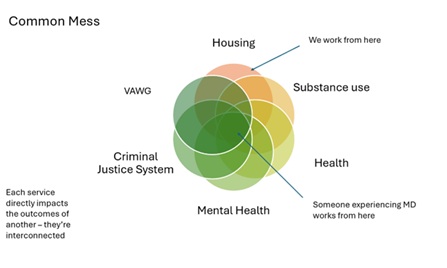
Capturing the depth of detail of a person’s experience of multiple disadvantage requires more than our current lagging metrics, and our access to the information that is available across the system. This means embedding mature data sharing frameworks and agreements into our partnerships founded on a relationship of common purpose.
This also requires common data pools with readily available analysis that can react to the swift changes in a person’s experience to best understand how to build support around them. We must also give parity to both service-specific and experiential data to really understand how the system functions, how an interaction was experienced by the individual who experienced it, and what that means overall for us as a support system.
A robust metrics/outcomes framework should also include perspectives from the individual themselves, and the people who have built relationships with them, i.e., the team around them, and possibly friends and family. We have to understand the human feeling and the impact this holds on everyone involved.
For example, a metric that shows 50 unplanned A&E attendances in one month, being reduced to 20 in the next after an intervention where a person has been registered with a GP practice, doesn’t accurately describe the qualitative success of diverting someone away from a crisis service into a planned and supportive service. This is coloured in by personal account, celebrating the change and understanding the scale of the change for that individual.
We assert that measuring real-time pressure in specific parts of the system to understand which services and individuals are strained will allow our support services to catch up to the real time and changing needs of the individuals who are experiencing multiple disadvantage locally. If this method of data measurement is plugged in to the wider system, not confined within or reliant on one lead service, we are confident that there will be positive implications for our work locally and support nationally. We explore more on how Changing Futures Sussex has been experimenting with this and the benefits it brings, in our blog for next week: Systems Pressure Mapping: Finding a New Way.